
Drug‑Free Migraine Relief: A Conversation with Theranica CEO Alon Ironi

Migraine is a progressive disease that impacts all areas of life. Without effective treatment, it can get worse.
For those who can't take or tolerate medications for migraine, FDA-cleared migraine devices are crucial for disease management. Despite this, healthcare professionals are often unaware of such devices, or tend to dismiss them as “experimental.” Patients, on the other hand, are bombarded on social media by non-evidence-based treatment options, and tend to have only a cursory awareness (at best) of FDA-cleared migraine devices.
I recently had the pleasure of talking about this with Alon Ironi, CEO and Co-Founder of Theranica—the company that makes Nerivio Infinity, a drug-free, FDA-cleared wearable medical device for migraine.
In our interview, Alon digs into big themes: the role of medical devices in migraine care, the failures of the healthcare and insurance systems, and the crucial importance of patient advocacy.
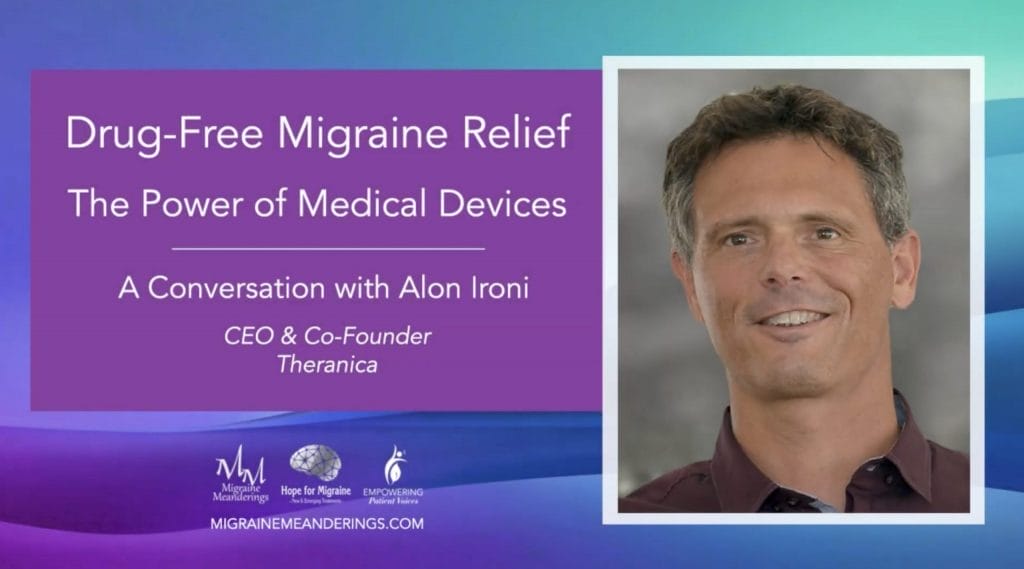
Watch my interview with Alon Ironi in its entirety, here.
A Personal Journey into Migraine
Alon doesn’t come from a traditional medical background. He’s an electrical engineer and longtime high‑tech CEO, who reached a point in his career where he wanted his work to have a deeper impact.
“My partners and I felt "it’s about time we do something really useful for this world… utilizing our know‑how and experience.”"
The turning point was personal: his older daughter started suffering from migraine at age 14. Watching her struggle with the long road to diagnosis, limited treatment options, and ongoing disability pushed him toward migraine specifically.
“I… witnessed and accompanied her through the misery of being a person who lives with migraine… the long time it took to diagnose, and then the lack of decent therapies… I felt, yeah, if it’s healthcare, let’s make it migraine.”
This combination of technical expertise and lived family experience became the foundation for Theranica and their wearable medical device, Nerivio Infinity.
Building Theranica: Longer, Harder, and More Complicated than Expected
Alon describes Theranica’s journey as fascinating but far more difficult and longer than anticipated.
“It’s been longer than we expected… and honestly, much more difficult. I’m not sure if we knew at the time… that it was going to be so difficult, if we would have pursued it.”
The team had to rapidly learn multiple new domains:
- Neuroscience and migraine pathophysiology
- Clinical trials and regulatory science
- The U.S. healthcare and reimbursement landscape
He notes that moving from engineering into healthcare meant confronting a system where drug‑centric thinking dominates, and reimbursement structures often push patients toward the cheapest—not necessarily the best—therapies.
“We met the whole school of HCPs that are fixated on drugs, because that’s what they learn in medical school… [and] a reimbursement system that…does its best to make patients settle on the cheapest therapies rather than what really works for them.”
Despite these obstacles, what keeps him going is the impact on real people:
“Every time I get frustrated at work, what I do is I go to one or two of our patient testimonials… and I’m like, okay, we’re doing the right thing… It energizes me.”
Mission: Patient‑Friendly, Evidence‑Based Migraine Care
One thing that hasn’t changed over time is Theranica’s mission:
“The mission remains the same… to improve the quality of life of people suffering from migraine… through creating access to innovative, patient‑friendly therapies.”
In practice, this means focusing on:
- Drug‑free, neuromodulation‑based approaches
- Solid clinical evidence and FDA clearance
- Real‑world access, including insurance coverage and telehealth pathways
Where Do Devices Belong in the Migraine “Toolbox”?
Alon is clear that medical devices should not be a last‑ditch option.
“Medical devices are… a very important component or tool in the [migraine] box, especially… for prevention.”
He emphasizes that preventing attacks is more beneficial than only treating them after they start, and that devices—when backed by strong data—should be considered early in the treatment journey:
“Devices… that have strong clinical evidence for prevention… must be prescribed early on. Without hesitation. There’s nothing to lose with that… At the worst, they’re not going to help. But usually they are, and there’s no risk, no drug‑drug interaction, no systemic side effects.”
He also pushes back against the tendency to lump all devices together, from cheap online gadgets to rigorously tested medical equipment:
“Sometimes all devices are treated as one bucket… You can’t talk about devices [that way]. There are… wellness devices… and then there are devices that are authorized by the FDA and went through… rigorous a process.”
Clinical Trials and FDA Standards
Although device trials are structured somewhat differently from drug trials, Alon stresses that FDA‑cleared devices are held to serious scientific standards.
“If you go through the FDA machine, you have to go through a very rigorous, predefined set of criteria… randomized controlled… against placebo… with blindness. The clinical endpoints have to be accepted by the relevant medical society.”
By contrast, manufacturers who skip regulatory clearance can design their own studies and define success without oversight—a key reason why FDA clearance matters for patients trying to sort real treatments from hype.
Why Insurance Coverage Became Essential
Interestingly, Theranica did not initially plan to pursue insurance coverage.
“Our intention was not even to address insurance… We thought we could have a business model without insurance.”
But they quickly learned that for patients, coverage is non‑negotiable:
“Patients… if they get a prescription from their physician, their appointment is covered by insurance. They expect that whatever results from that appointment will also be covered.”
This realization pushed Theranica to:
- Invest heavily in health‑economic evidence
- Build demand (even at a financial loss) through patient assistance
- Work closely with advocacy groups and physicians to persuade payors
Today, the Nerivio Infinity is the first and only FDA‑cleared prescription migraine device with national commercial insurance coverage as well as growing Medicaid coverage.
The Essential Role of Patient Advocacy
Throughout the interview, Alon repeatedly returns to the power of patient advocacy organizations:
“Migraine patient advocacy [groups] are the perfect type of organization to educate patients... There's so much noise out there.”
He sees patient advocates as critical for:
- Explaining FDA-clearance, clinical evidence, and device differences
- Teaching patients how to appeal denials and request formulary exceptions
- Helping patients insist on the treatments they deserve, not just the cheapest or best known options
“They can guide patients through what tools they have, what channels they have, to really… insist on their rights… Most patients don’t know that. They just get the denial and they accept it.”
In the end, his message to patients, providers, and payors is aligned: put patient outcomes first, recognize the value of evidence‑based, drug‑free options, and use advocacy and persistence to turn theoretical access into real‑world treatment.
LET US KNOW! Have you tried a migraine device to stop or prevent attacks? What was your experience - did it help? And what is the biggest barrier for you in trying a device?
This article is for educational purposes only and does not replace medical advice from your medical team. This information was taken from our conversation with Alon Ironi, Theranica CEO, and formatted with the help of Otter AI.